Machine learning, Deep learning and data science
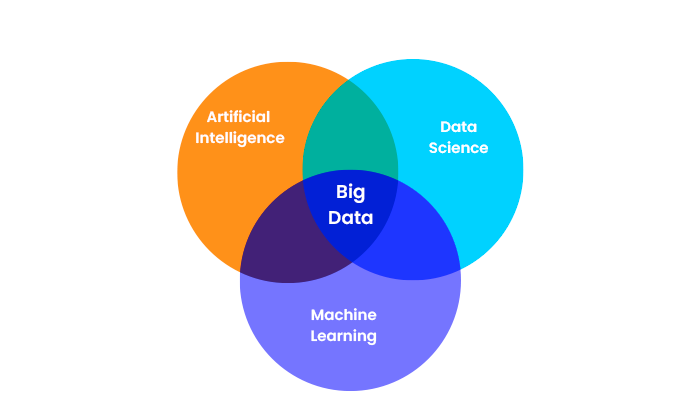
When I started my journey of learning artificial intelligence and machine learning, I had a lot of confusion wasn't anything technical but how it differs from one another and how extent it is related to each other.
I heard a lot of words like big data, data science, deep learning, machine learning and artificial intelligence. within these scopes, there are still many words that arouse curiosity.
You might have wondered how they differ. Hopefully, today I would be able to clear your doubts.
one article that I have got in-depth about artificial intelligence.
Machine Learning:
Machine learning is the subset of Artificial intelligence that provides the system the ability to automatically learn and improve from the experience without being explicitly programmed.
Machine learning focuses on the development of computer programs that can access data and use it to learn for themselves. The primary aim is to allow computers to learn automatically without human intervention.
Real-time applications of Machine learning:
Email spam filtering.
Product recommendation.
Social Media services.
Approval of bank loan.
Deep Learning:
Deep learning is a method in artificial intelligence that teaches computers to process data in a way that is inspired by the human brain.
Deep learning models can recognize complex patterns in pictures, text, sounds and other data to produce accurate insights and predictions.
Deep learning methods can use to automate tasks that typically require human intelligence.
Real-time applications of Deep Learning:
smart agriculture
Supercomputers
Autonomous vehicles
Fraud detection
Computer Vision:
Computer vision is a field of artificial intelligence that trains computers to interpret and understand the visual world. Computers can use digital images and deep learning models to accurately identify and classify objects and react to them.
Massive amounts of information are required for computer vision and data analysis is performed until the system can differentiate between objects and identify visuals.
Real-time applications of Computer Vision:
Face recognition
Self-driving cars
X-ray analysis.
Predistrian analysis and road condition monitoring.
Natural Language Processing:
NLP is a branch of data science that consists of systematic processes for analyzing, understanding, and deriving information from text data smartly and efficiently. By utilizing NLP and its components, one can organize massive chunks of text data, and perform numerous automated tasks.
Real-time applications of Natural Language Processing:
Sentiment analysis.
Language Translation.
Chatbots.
Data Science:
Data science is the field of study that combines domain expertise, programming skills and knowledge of mathematics and statistics to extract meaningful insights from the data. In specific, data science is the study of data to extract meaningful information insights for the business.
Real-time applications of Data Science:
Health care- identifying the patient's disease.
Transportation- identifying the shipping routes.
Gaming - improving the gaming experience.
Sports- evaluating the athlete's performance.
Big data:
Big Data is a collection of data that is huge in volume, yet growing exponentially with time. It is data with so large a size and complexity that none of the traditional data management tools can store it or process it efficiently. Big data is also data but with a huge size.
Real-time applications of Big data:
Big Data powers the GPS smartphone applications most of us depend on to get from place to place.
Fraud detection, and customer relationship management in Banking services.
Comments
Join the discussionNo comments yet. Be the first to comment.